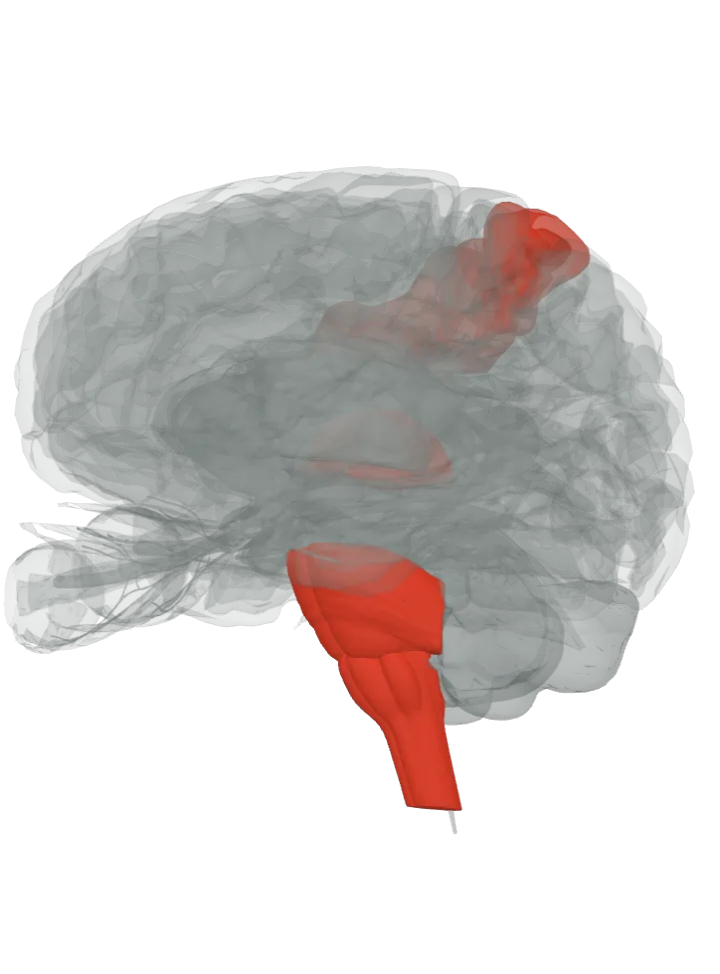
It carries touch, pain and temperature from the face: in through the trigeminal nerve at the pons, to its sensory nuclei in the pons and medulla, across the midline in the trigeminal lemniscus to the ventral posteromedial nucleus (VPM) of the thalamus, and up to the face area of the postcentral gyrus. [1][2][3]
A tract has no shape of its own in this atlas; lit: the parts it runs through, in order.
The brain starts seen from the left, a little from the front and below, so the pons where the nerve enters, the medulla below it and the gyrus behind the central sulcus all show. Step through lights one step at a time, about 1.2 s each, from the brainstem up; tap a step below to light it. The lit step is in the bright highlight colour, the steps before it stay lit in a paler tint of it and the steps still ahead are grey. Drag to turn, pinch or scroll to zoom. Step through is off because your device asks for reduced motion; tap each step instead.
Each step lights the whole part, not the narrow course of the fibres inside it. The atlas has no shape for the trigeminal nerve's root, its ganglion, its nuclei or the VPM, so the nerve and nuclei steps light the pons and medulla that hold them and the thalamus is lit whole; the whole postcentral gyrus lights, though the face takes only its lower part. [4][1]
The route, in 4 steps
Touch, pain and temperature from the face, eye surface, nose, mouth and teeth travel in the three divisions of the trigeminal nerve, ophthalmic (V1), maxillary (V2) and mandibular (V3), whose cell bodies sit in the trigeminal ganglion. From the ganglion a single large sensory root enters the brainstem at the level of the pons. The nerve has no shape in this atlas; lit: the pons it enters. [1]Where is the trigeminal nerve (CN V)?
Inside the brainstem the fibres part by what they carry. Fine (discriminative) touch from the face ends in the principal sensory nucleus, which sits inside the pons near where the nerve enters. Pain, temperature and crude touch end in the spinal trigeminal nucleus, which sits inside the medulla oblongata. A third, the mesencephalic nucleus in the midbrain, takes signals from receptors of the jaws and teeth and is not one of these steps. Not separate shapes in this atlas; lit: the parts that hold them, the pons and the medulla oblongata. [1][5][6][3]Where is the pons?Where is the medulla oblongata?
Crossing in the brainstem: the second-order axons of the spinal trigeminal nucleus cross the midline and climb to the thalamus of the opposite side as the ventral trigeminal tract; most from the principal sensory nucleus cross too, but those carrying the inside of the mouth climb on the same side in the dorsal trigeminal tract. Together these tracts are the trigeminal lemniscus. So from the brainstem upward, each side carries the opposite half of the face. The atlas has no shape for the crossing, so it is not marked. [2][5][6]
The trigeminal lemniscus ends in the thalamus, on third-order neurons of the ventral posteromedial nucleus (VPM), the inner part of the ventral posterior nucleus; touch from the body ends beside it, in the ventral posterolateral nucleus (VPL). Not a separate shape in this atlas; lit: the part that holds it, the thalamus. [2][1][7]Where is the ventral posterior nucleus (thalamus, VPM)?
From the VPM the third-order axons project to the primary somatosensory cortex of the parietal lobe, the postcentral gyrus. Its map of the opposite half of the body puts the face low down the side of the gyrus, below the hand, while the leg lies at the top near the midline, so the face's signals light only the lower part of what is lit here. [1][3][8]Where is the postcentral gyrus?
It is the face's counterpart of the two body routes: the spinal trigeminal nucleus takes the same kinds of signal as the spinothalamic tract (pain, temperature, crude touch), the principal sensory nucleus those of the dorsal column pathway (fine touch), and all of them relay in the ventral posterior nucleus of the thalamus. [3][1][7]
Like the body routes it is a chain of three neurons: trigeminal ganglion to the brainstem nuclei, the nuclei to the VPM of the thalamus, the VPM to the cortex. [3][2]
Touch and position signals from the face travel in myelinated, fast-conducting fibres; pain and temperature in unmyelinated fibres. [1]
Facts describe anatomy and normal function only. The 3D model is the adult male BodyParts3D brain (credits and licence); it has no shape for tracts, so a pathway is shown by the parts it runs through.