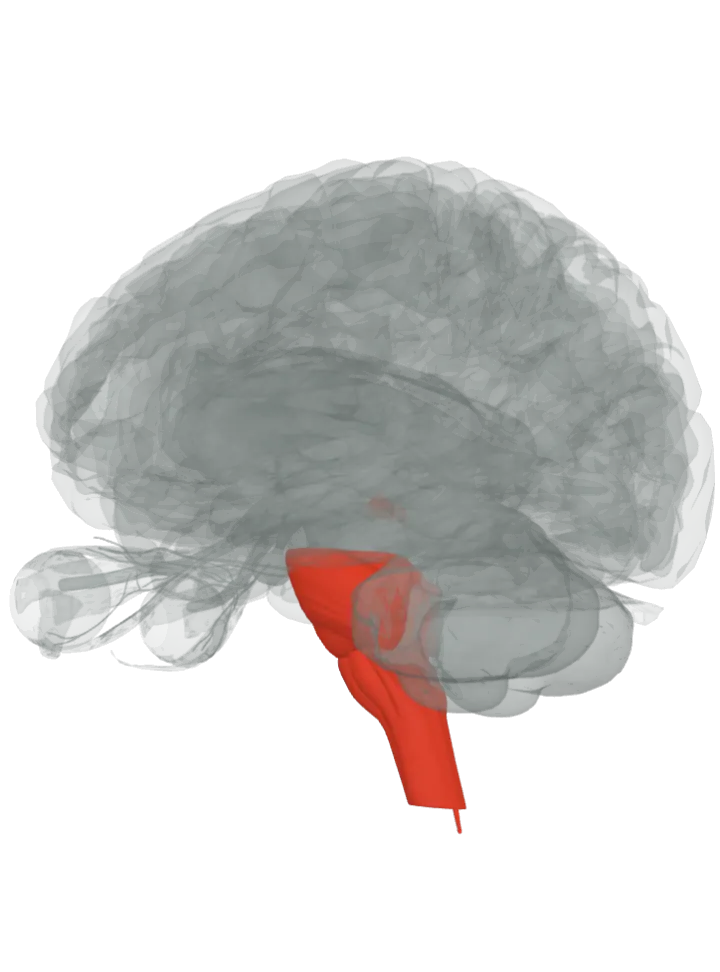
It starts in the superior colliculus on the roof (tectum) of the midbrain, crosses the midline in the midbrain at once and runs down through the pons and medulla into the spinal cord, only as far as the neck and upper back. It turns the head and eyes towards something seen or heard. [1][2]
A tract has no shape of its own in this atlas; lit: the parts it runs through, in order.
The brain starts seen from the left, a little from behind and below, so the superior colliculus on the back of the midbrain and the brainstem below it both show. Step through lights one step at a time, about 1.2 s each, top to bottom; tap a step below to light it. The lit step is in the bright highlight colour, the steps before it stay lit in a paler tint of it and the steps still ahead are grey. Drag to turn, pinch or scroll to zoom. Step through is off because your device asks for reduced motion; tap each step instead.
The tract itself is not drawn: the first step lights the superior colliculus it starts in, each later step the whole part the tract runs through. The atlas has only the top of the spinal cord, drawn as its thin central canal. [3][1]
The route, in 4 steps
The tract starts in the deep layers of the superior colliculus, the upper pair of small bumps on the back of the midbrain. That roof is called the tectum, which gives the tract its name; OpenStax notes that tectum is also used as another name for the superior colliculus. [1][4]Where is the superior colliculus?
Crossing in the midbrain: straight after leaving the colliculus the fibres cross the midline in the back part of the midbrain tegmentum, at the level of the red nucleus, so each superior colliculus reaches the opposite side of the spinal cord. The atlas has no shape for the crossing, so it is not marked. [1]
Now on the opposite side, the fibres turn downwards through the pons, the part of the brainstem that lies below the midbrain and above the medulla; the cited source picks them up again in the medulla. [5][1]Where is the pons?
In the medulla the fibres run down near the midline inside the medial longitudinal fasciculus, the bundle that also carries signals about which way the eyes should move between the nuclei of the eye-moving nerves. [1][6]Where is the medulla oblongata?
In the spinal cord the tract runs in the anterior funiculus and reaches only the cervical and upper thoracic segments, where it ends on interneurons of the intermediate zone and the anterior grey column: it acts on the neck and upper trunk, not the legs. [1]Where is the spinal cord?
More about the tectospinal tract
Other names: colliculospinal tract, tectospinal fasciculus [1]
It mediates reflex turning of the head and upper trunk towards a sudden stimulus, whether it is seen, heard or felt on the skin. [1]
The superior colliculus holds a map of the space around the body: its surface layers take input from the eyes only, its deep layers, where this tract starts, also from hearing and touch. Activity at one point of the map turns the eyes and head towards the matching point in space. [2]
The colliculus encodes the target of a gaze shift, not the exact movement: how the shift is split between turning the eyes and turning the head is worked out further down, in brainstem motor areas, in ways the source says are not yet well understood. [2]
Facts describe anatomy and normal function only. The 3D model is the adult male BodyParts3D brain (credits and licence); it has no shape for tracts, so a pathway is shown by the parts it runs through.