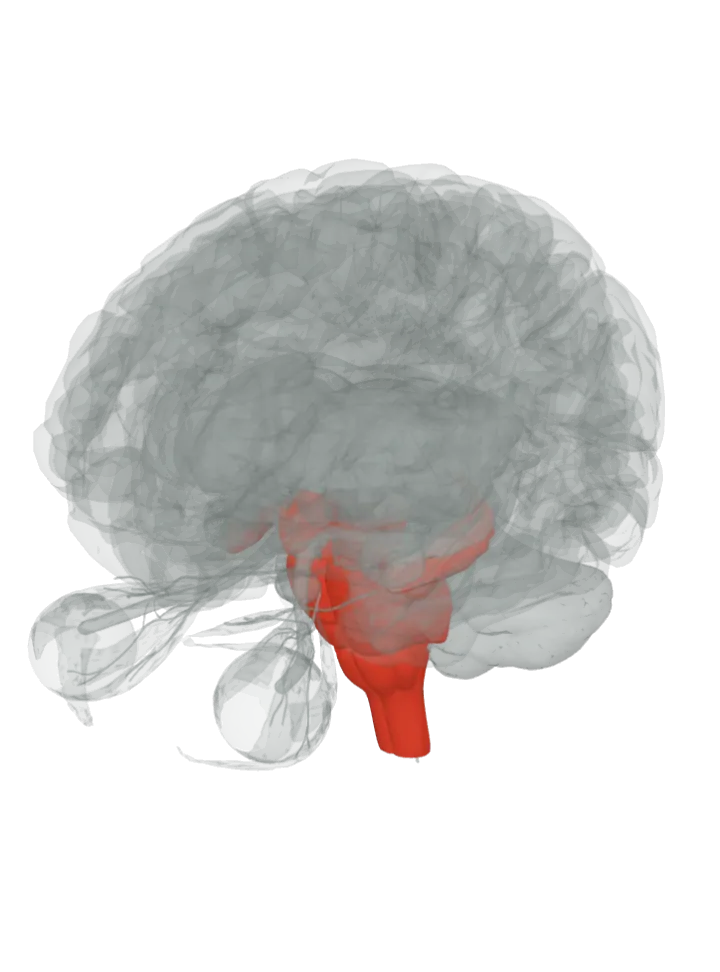
Mainly the hypothalamus and the brainstem. A yawn is set off by the paraventricular nucleus of the hypothalamus, and its motor sequence is passed down through the brainstem to the spinal cord. The nucleus’s oxytocin neurons do it by releasing oxytocin at sites away from it, the hippocampus, the pons and the medulla oblongata, which is known mostly from rats. [1][2]
All 5 parts are lit together. Drag to turn, pinch or scroll to zoom, tap a part on the brain or a name in the list to focus it; .
The paraventricular nucleus is a region on the hypothalamus, not a separate shape. The 3D model has no shape for it, so the whole hypothalamus is lit; the region’s exact border is not drawn.
The reticular formation is a region on the brainstem, not a separate shape. The 3D model has no shape for it, so the whole brainstem is lit; the region’s exact border is not drawn.
How they work together
A yawn is a reflex: a long breath in as the mouth slowly gapes, a brief peak with muscle stretching, then a quick breath out with the muscles relaxing, usually about six seconds in all. Almost all vertebrates yawn, fish included, and a yawning fetus has been filmed at 30 weeks of pregnancy. [3]
Many chemicals tune it: dopamine, excitatory amino acids, acetylcholine, serotonin, nitric oxide, ACTH-related peptides and oxytocin make a yawn likelier and opioid peptides make it less likely; several of them meet in the paraventricular nucleus, though yawns brought on by acetylcholine, serotonin or ACTH do not seem to need its oxytocin neurons. [2]
Seeing, hearing, reading or even thinking about a yawn can start one; the cause may lie with mirror neurons in the frontal cortex, a proposal rather than a mapped circuit, and contagious yawning is not reliable in children under about six. [3]
Why we yawn is still open. Contagious yawns dropped with a cold pack on the forehead or when people breathed only through the nose, which fits a brain-cooling idea; across mammals, longer yawns go with heavier brains and more cortical neurons (correlations above 0.9), and primates yawn longer than other mammals. [3][4]
Honest limit: these are networks seen in animal work, not single centres; the paraventricular nucleus and the hippocampus, pons and medulla release sites come from rats, not human scans, the 2025 review says the exact circuits still need imaging and recordings to pin down, and the paraventricular nucleus and reticular formation are regions on lit parts, so whole parts are lit, not exact borders. [2][1][5]
Yawns come with tiredness and boredom and may raise alertness through the brainstem’s reticular activating system, which helps run wakefulness. [1]What part of the brain controls sleep?
Facts describe anatomy and normal function only. A part lit here takes part in yawning; it does not do it alone, and it does other jobs too. The 3D model is the adult male BodyParts3D brain (credits and licence); on it the brainstem includes the midbrain, pons and medulla, so lighting the brainstem lights all three.