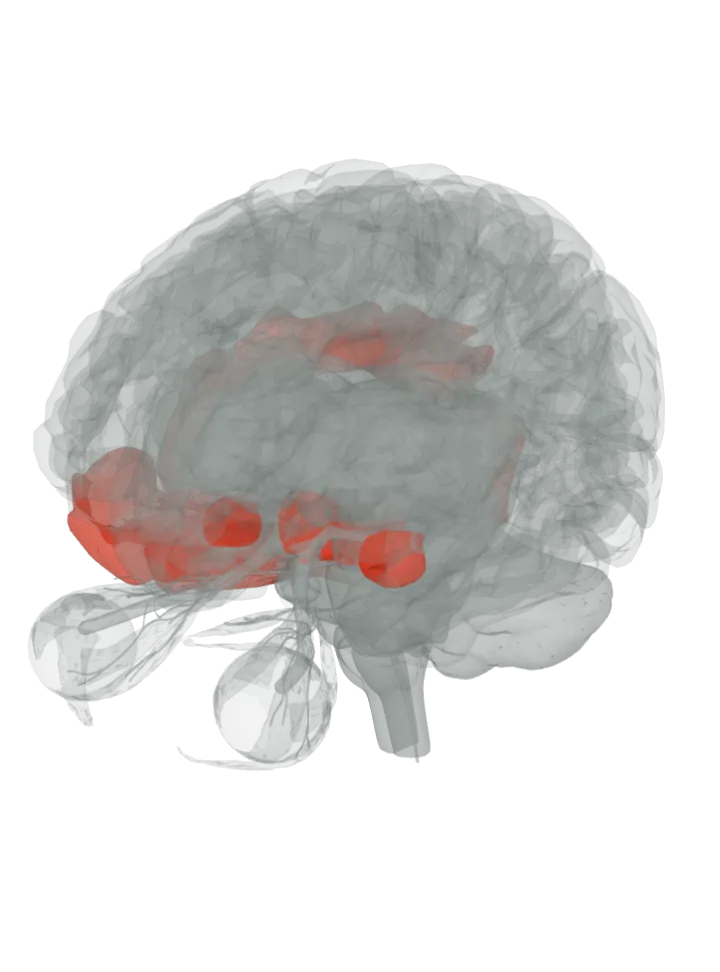
No single part. Animal studies point to an acute threat circuit, the amygdala, the hypothalamus and the periaqueductal grey in the midbrain, that drives the attack-ready reaction; electrically stimulating the hypothalamus alone can set off aggression. In people, brain scans during anger most consistently light the orbitofrontal cortex, and activity in the anterior cingulate cortex rises with how angry people say they feel. [1][2][3][4]
All 5 parts are lit together. Drag to turn, pinch or scroll to zoom, tap a part on the brain or a name in the list to focus it; .
The anterior cingulate cortex is a region on a lit gyrus, not a separate shape. The 3D model draws only whole gyri, so the gyrus that holds each area is lit; the area’s exact border is not drawn.
The periaqueductal grey is a region on the midbrain, not a separate shape. The 3D model has no shape for it, so the whole midbrain is lit; the region’s exact border is not drawn.
How they work together
Anger is an intense emotional state, a strong, uncomfortable and non-cooperative response to a perceived provocation, hurt or threat. Aggression is the behaviour, and the two do not always come together: the 2016 review notes aggression that is not accompanied by anger at all. [3][1]
The body joins in through the same chain: anger switches on the hypothalamic–pituitary–adrenal axis, heart rate and blood pressure rise, breathing through the nose gets faster, deeper and irregular, and the surge of stress chemicals is more noradrenaline than adrenaline. [3]
Whether the threat circuit’s push turns into an act is decided further forward: the review gives response selection to the ventromedial frontal cortex and the dorsomedial frontal and anterior insula cortex, and the prefrontal cortex is crucial for self-control and for holding back impulses, aggression and emotions included. [1][2]
Feeling anger and dwelling on it are separable in scans: after an insult, dorsal anterior cingulate activity tracked how angry people felt, while medial prefrontal activity tracked how much they went over it afterwards. [4]
Honest limit: these are networks seen in imaging and animal work, not single centres; the hypothalamus, periaqueductal grey and amygdala findings come mostly from stimulation in cats, rats, hamsters and monkeys, the amygdala’s part in primates depends on the situation, the human scans are small (eight men in the PET study), and the periaqueductal grey and anterior cingulate cortex are regions on lit parts, so whole parts are lit, not exact borders. [2][5][6]
Anger and fear draw on the same acute threat circuit of amygdala, hypothalamus and periaqueductal grey; the fear page lights those with the hippocampus, prefrontal cortex and insula. [1]What part of the brain controls fear?
The hypothalamus starts something much calmer too: its paraventricular nucleus sets off a yawn, passed down through the brainstem. [7]What part of the brain makes you yawn?
Facts describe anatomy and normal function only. A part lit here takes part in anger; it does not do it alone, and it does other jobs too. The 3D model is the adult male BodyParts3D brain (credits and licence); on it the brainstem includes the midbrain, pons and medulla, so lighting the brainstem lights all three.