Where are the pars opercularis, pars triangularis and pars orbitalis?
The inferior frontal gyrus, the lowest of the frontal gyri on the side of the frontal lobe, has three parts. From back to front: the pars opercularis (Brodmann area 44), the pars triangularis (area 45) and the pars orbitalis (area 47). The first two make up Broca’s area. [1]
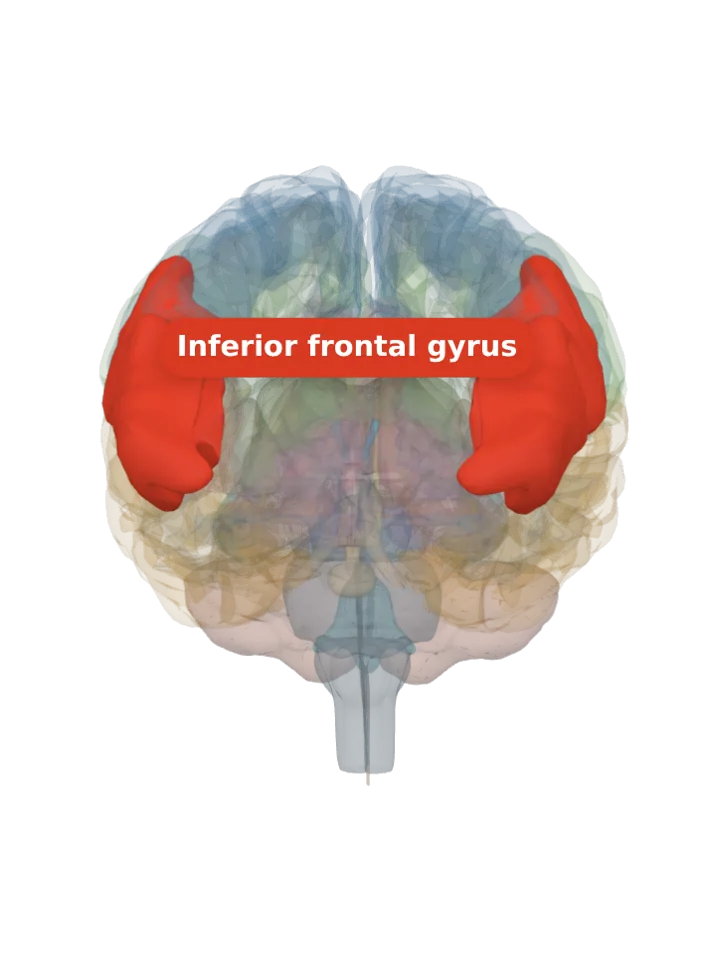
The whole inferior frontal gyrus is lit, low on the side of each frontal lobe just above the lateral sulcus. Turn the brain to look at its side: from back to front along the lit gyrus lie the pars opercularis (next to the precentral gyrus), the pars triangularis and the pars orbitalis, which bends onto the underside. Drag to turn, pinch or scroll to zoom, tap any part to name it; .
Lit: the whole inferior frontal gyrus, on both sides. This atlas draws the part it lies in as one shape, so it cannot be lit apart; lit: that whole part. They are the three subdivisions of the inferior frontal gyrus, marked off by two branches (rami) of the lateral sulcus. BodyParts3D draws each inferior frontal gyrus as one shape with no opercular, triangular or orbital part of its own, so the whole gyrus is lit and no line is drawn between them. [1][2]
The pars opercularis and the pars triangularis, Brodmann areas 44 and 45, make up Broca’s area; the pars orbitalis is not part of it. [1][3]
The pars opercularis is the back part, behind the ascending ramus of the lateral sulcus; it is the part of the frontal lobe that overlies the insula, and the inferior precentral sulcus bounds it behind. [1][4]
The pars triangularis is the middle part, between the ascending ramus and the horizontal (anterior) ramus of the lateral sulcus. [1]
The pars orbitalis is the front part, below and in front of the horizontal ramus; it bends onto the underside of the frontal lobe, borders the insula in the depth of the lateral sulcus and is bounded in front and below by the lateral orbital sulcus. [5][6]
The pars opercularis (BA44) is involved in language production and sound-level (phonological) processing, through its connections with the motor areas for the mouth and tongue; the left one is part of the articulatory network with the premotor cortex and the front of the insula. [1]
The pars triangularis (BA45) is involved in semantic processing, the meaning of words. With BA44 it makes up Broca’s area, which is active in tasks such as deciding whether a word names something abstract or concrete, or producing a verb that goes with a noun; its exact role there is still debated. [1][7]
The pars orbitalis (BA47) has been linked to processing syntax in spoken and signed languages, musical syntax and the meaning of words and sentences. [6]
The right pars opercularis (BA44) has been implicated in go/no-go tasks, where a person must stop an action already under way. [1][4]
Connections
BA44 tends to receive more incoming connections from motor, somatosensory and inferior parietal regions; BA45 receives more from the prefrontal cortex. [3]
The arcuate fasciculus has long been described as joining Broca’s area to Wernicke’s area; it is now understood to connect the language regions further back with the premotor and motor cortices rather than the two areas directly. [3][8]
Other names
Brodmann area 44 is the pars opercularis (opercular part), Brodmann area 45 the pars triangularis (triangular part) and Brodmann area 47 the pars orbitalis (orbital part). [1]
Brodmann area 47 and the pars orbitalis are not exact synonyms: the pars orbitalis is a gyral region seen by eye, area 47 a region defined by its cell layers, though the two names are often used interchangeably. Some researchers call it BA47/12. [5][6]
Size
The model has no shape for the pars opercularis, triangularis and orbitalis itself, so it is not measured here. The whole left inferior frontal gyrus that holds it measures about 63 mm front to back, 60 mm top to bottom and 35 mm side to side on this model (the box it fits in, not its volume). [2]
Facts describe anatomy and normal function only. The 3D model is the adult male BodyParts3D brain (credits and licence); real brains vary in size and shape, so its measurements describe one model, not anyone’s brain.