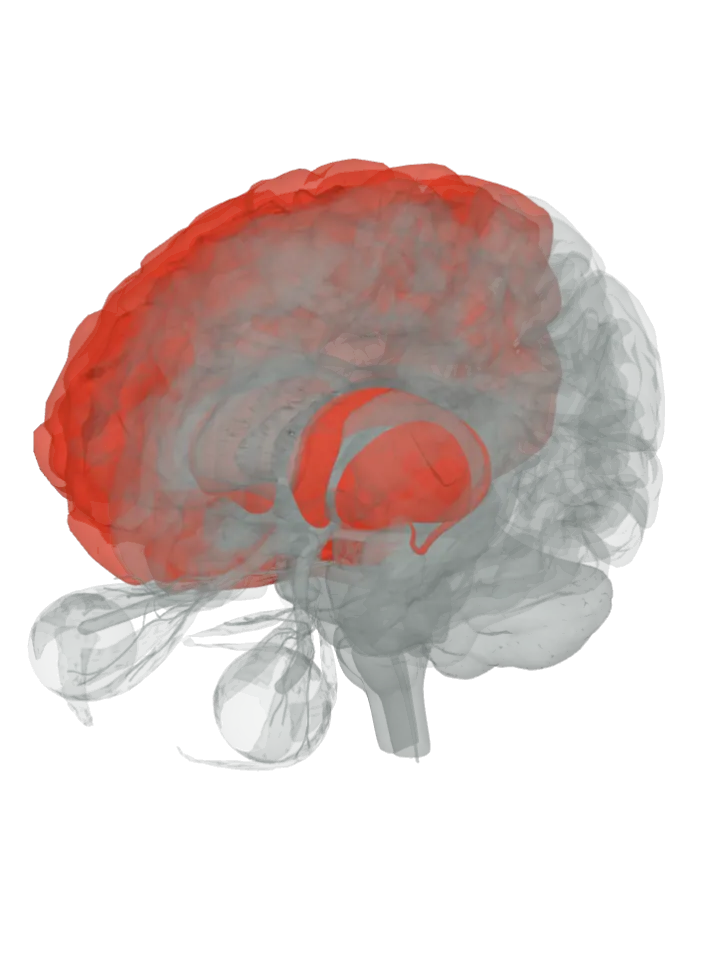
Mostly the basal ganglia, in a loop with the cortex. As an action is repeated, its control shifts from the goal-directed caudate nucleus to the putamen (the dorsolateral striatum), which runs the routine as one chunk; that habit circuit depends on dopamine from the substantia nigra in the midbrain. The motor cortex feeds the putamen, and part of the prefrontal cortex helps a new habit take hold. [1][2][3]
All 5 parts are lit together. Drag to turn, pinch or scroll to zoom, tap a part on the brain or a name in the list to focus it; .
The substantia nigra is a region on the midbrain, not a separate shape. The 3D model has no shape for it, so the whole midbrain is lit; the region’s exact border is not drawn.
How they work together
A habit is defined by a test, not by how often something is done. If the reward is made worthless and the animal still presses the lever for it, the action has become a habit; an action that is still goal-directed slows down. Repetition moves an action from the second kind to the first. [1][2]
Habits are packed into chunks. In rats running a T-shaped maze, striatal neurons came to fire mostly at the start and the end of each run, bracketing it, and the rats stopped pausing to deliberate at the turn; the same chunking pattern shows up in the infralimbic cortex. [1]
The basal ganglia appear to remember the context that triggers a habit and can revive the habit when the trigger comes back, which is why a cue, the routine and its reward are described as one loop. In a 2002 study about 43% of daily behaviours were done out of habit; in a study by Lally and colleagues a new daily behaviour took on average 66 days (range 18 to 254) to become as automatic as it would get. [7]
Honest limit: most of this circuit was mapped in rats, mice and monkeys; in people it rests on brain imaging, and matching the rat’s dorsolateral and dorsomedial striatum and infralimbic cortex to the human putamen, caudate nucleus and prefrontal cortex is approximate. The whole putamen, caudate nucleus and prefrontal cortex are lit, not their exact habit subregions, and the page describes how ordinary habits form, nothing about any one person’s. [1][4]
Habits are one kind of learning: the learning page lights the hippocampus, which takes in new facts, and the cerebellum, which tunes skilled movement, beside the same striatum. [8][9]What part of the brain is responsible for learning?
Facts describe anatomy and normal function only. A part lit here takes part in habits; it does not do it alone, and it does other jobs too. The 3D model is the adult male BodyParts3D brain (credits and licence); on it the brainstem includes the midbrain, pons and medulla, so lighting the brainstem lights all three.