brainlocation

For learning, not medical advice.

All parts of the brain › Functions › Intelligence

What part of the brain controls intelligence?

No single part: the best-known model, Jung and Haier’s parieto-frontal integration theory (P-FIT), ties intelligence to a network centred on the dorsolateral prefrontal cortex and the inferior and superior parietal lobules. [1][2]

Honest limit: P-FIT is one model, built from imaging studies of groups; intelligence is not located in one place, and this page says nothing about any person. [1][2]

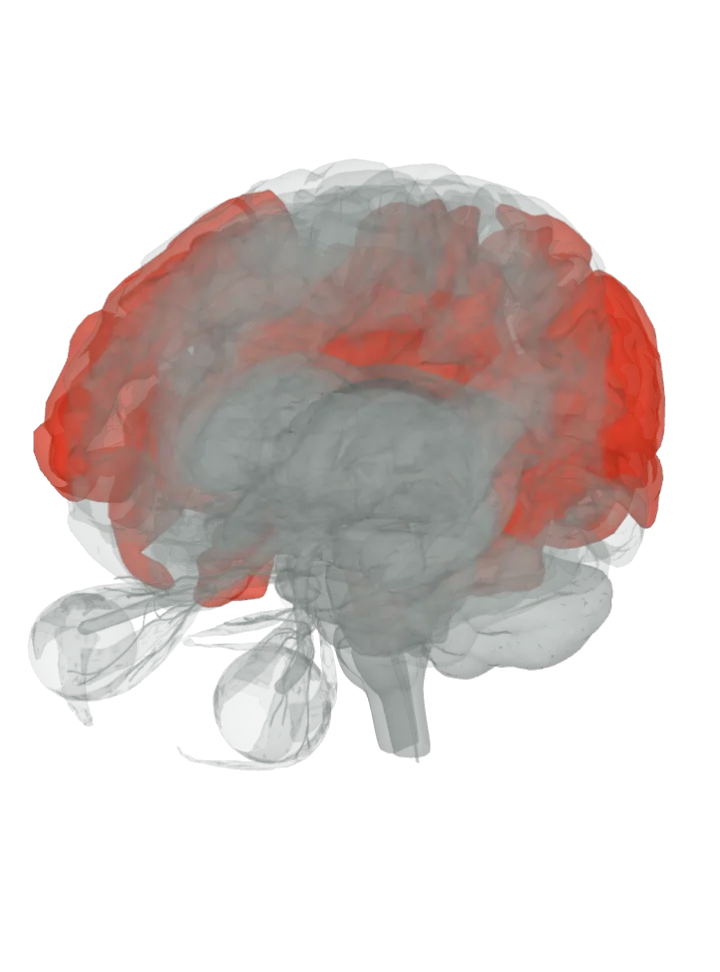
The occipital lobe, the fusiform gyrus, the superior temporal gyrus, the angular gyrus, the supramarginal gyrus, the superior parietal lobule, the middle frontal gyrus, the inferior frontal gyrus and the cingulate gyrus lit in red on a 3D model of the brain, seen from the front left and above

Loading the 3D brain…

Not lit: the frontal pole (not a shape in this model). Lit: whole parts; region borders not drawn.

Slice

All 9 parts are lit together. Drag to turn, pinch or scroll to zoom, tap a part on the brain or a name in the list to focus it; .

In it, temporal and occipital areas first take in what is seen and heard, the parietal cortex abstracts it, the frontal lobe tests ideas about it with the parietal cortex, and the anterior cingulate picks the answer and holds back the rest. [1][2]

Not lit: The frontal pole (Brodmann area 10), also named by the model, is not a separate shape in this 3D model, so it has no marker of its own. [2]

The dorsolateral prefrontal cortex, the anterior cingulate cortex and Wernicke’s area are regions on these gyri, not separate shapes. The 3D model draws only whole gyri, so the gyrus that holds each area is lit; the area’s exact border is not drawn.

How they work together

  • Where the model comes from: Jung and Haier (2007) reviewed 37 structural and functional imaging studies with 1,557 participants in total, published between 1988 and 2007, and kept the regions that kept turning up when test scores were set against brain scans. Many more regions turned up in single studies; the synthesis keeps fewer. [1][2]
  • Four stages, one loop: sensory areas in the occipital and temporal lobes, abstraction in the parietal cortex, hypothesis testing between the parietal and frontal lobes, and response selection in the anterior cingulate. The model treats the link between them as part of the answer: white matter, especially the arcuate fasciculus, is thought to carry the traffic reliably. [2]
  • Efficiency, not size alone: later work tied higher scores to more efficient communication between the dorsolateral prefrontal cortex, the parietal lobe and the anterior cingulate. [1]
  • Honest limit: not all these areas are equally necessary in every individual, and the theory’s own literature stresses that people may reach the same answer with different cognitive and neural strategies. Structural and lesion studies show which regions matter but do little to show how the work unfolds moment to moment, and there is little published criticism of the model yet, so it is a summary of evidence, not a settled map. [2][1]

Working memory, keeping a few items in mind while you use them, leans on the same dorsolateral prefrontal and parietal cortex and has its own page. [9] What part of the brain controls working memory?

Sources

  1. Wikipedia: Parieto-frontal integration theory
  2. Colom, Karama, Jung & Haier (2010), Human intelligence and brain networks, Dialogues in Clinical Neuroscience 12:489 (open access)
  3. Wikipedia: Fusiform gyrus
  4. Wikipedia: Wernicke’s area
  5. Wikipedia: Inferior parietal lobule
  6. Wikipedia: Dorsolateral prefrontal cortex
  7. Wikipedia: Premotor cortex
  8. Wikipedia: Inferior frontal gyrus
  9. Wikipedia: Working memory
  10. Wikipedia: Frontoparietal network

Facts describe anatomy and normal function only. A part lit here takes part in intelligence; it does not do it alone, and it does other jobs too. The 3D model is the adult male BodyParts3D brain (credits and licence); on it the brainstem includes the midbrain, pons and medulla, so lighting the brainstem lights all three.