How they work together
- Two halves, one balance: the sympathetic division leaves the spinal cord in the thoracic and lumbar segments and readies the body for “fight or flight”; the parasympathetic division has a craniosacral outflow, from the brainstem and the sacral cord, and runs “rest and digest”. Together they set heart rate and its force, digestion, breathing rate, pupil size, urination and sexual arousal, mostly without you noticing. [2]
- The vagus nerve is the main parasympathetic route: it is the longest nerve of the autonomic system and carries parasympathetic fibres to every organ from the neck down to the transverse colon, except the adrenal glands; most of its fibres, between 80 and 90 per cent, are sensory, reporting on the organs back to the solitary nucleus. [2][6]
- Homeostasis is a loop of sensor, control centre and effector: for temperature, thermoreceptors in the hypothalamus itself feed a set point that is regularly reset, and autonomic nerves to blood vessels, sweat glands and organs make the correction. [14]
- A network, measured: pooling 43 brain-imaging studies of 615 people, Beissner and colleagues found the left amygdala, the right anterior and left posterior insula and the midcingulate cortex active across all autonomic tasks; sympathetic-linked regions sat mostly in the executive and salience networks, parasympathetic-linked ones in the default mode network, and the hypothalamus came out on the parasympathetic side. [3]
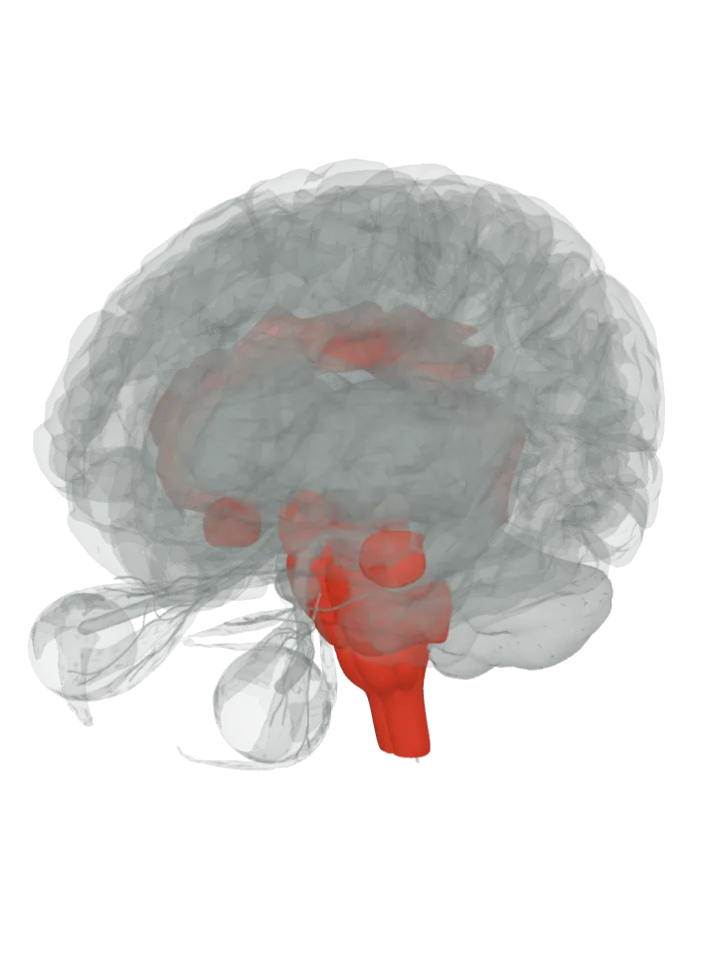
- Honest limit: the brainstem centres, the parabrachial nucleus, the locus coeruleus and the periaqueductal grey are small clusters of neurons with no shape of their own on this model, so the whole medulla, pons and midbrain light; the cortical roles come from imaging, which sees where activity rises, not what each region commands, and the meta-analysis drew on far fewer parasympathetic studies (8) than sympathetic ones (19); the spinal cord’s sympathetic chain, the ganglia, the gut’s own enteric nervous system and the organs are outside the model. [3][2][15]
The medulla’s cardiovascular centre, the sympathetic accelerator and vagal brake on the heart and the baroreflex that holds blood pressure steady each beat, has its own page. [1] What part of the brain controls heart rate and blood pressure?
The medulla’s respiratory centre and the pons’s pneumotaxic centre, which set the rhythm of each breath, have their own page. [5][7] What part of the brain controls breathing?
The sympathetic surge of fight or flight, and the slower hormone chain of the HPA axis that runs beside it, are on the stress response page. [16] What part of the brain controls the stress response?
Temperature is the textbook homeostasis loop, run from the hypothalamus. [14] What part of the brain controls body temperature?