brainlocation

For learning, not medical advice.

All parts of the brain › Functions › Vomiting reflex

What part of the brain controls vomiting?

In the medulla oblongata, at the bottom of the brainstem. [1][2][3]

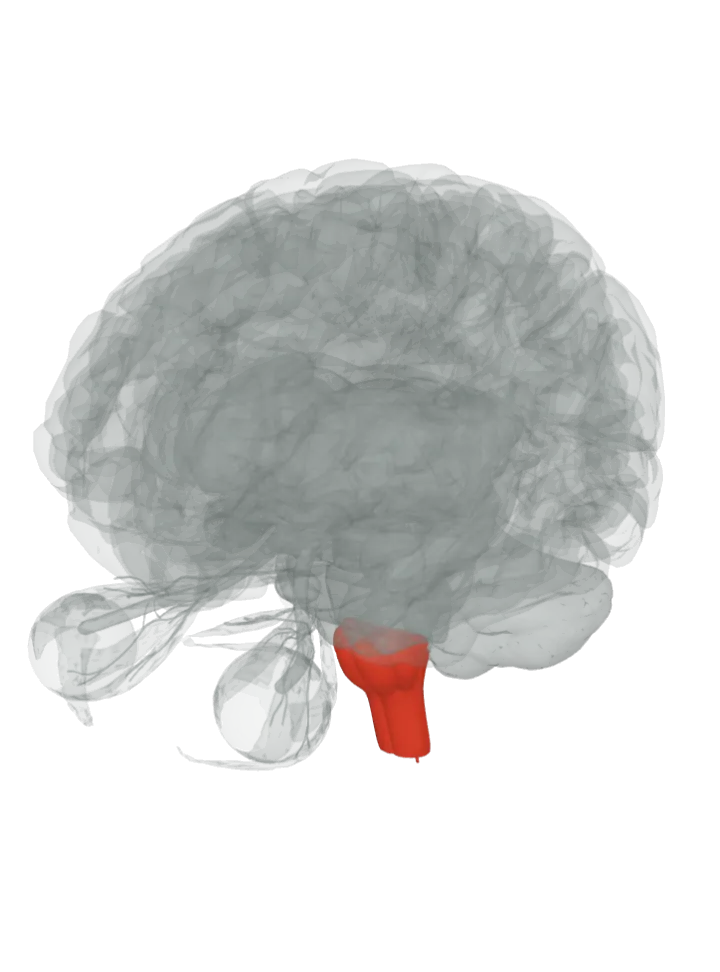
The medulla oblongata and the spinal cord (central canal) lit in red on a 3D model of the brain, seen from the front left and above

Loading the 3D brain…

Lit: whole parts; region borders not drawn.

Slice

All 2 parts are lit together. Drag to turn, pinch or scroll to zoom, tap a part on the brain or a name in the list to focus it; .

The “vomiting centre” is not one nucleus but loosely organised groups of neurons in the medulla. They act on signals from the area postrema, a chemoreceptor trigger zone on the floor of the fourth ventricle that samples the blood, and from the vagus nerve, which reports on the gut; both reach the solitary nucleus. The reflex is protective: it empties the stomach of something harmful. [1][2][3]

The area postrema is a region on the medulla oblongata, not a separate shape. The 3D model has no shape for it, so the whole medulla oblongata is lit; the region’s exact border is not drawn.

The solitary nucleus is a region on the medulla oblongata, not a separate shape. The 3D model has no shape for it, so the whole medulla oblongata is lit; the region’s exact border is not drawn.

The dorsal vagal nucleus is a region on the medulla oblongata, not a separate shape. The 3D model has no shape for it, so the whole medulla oblongata is lit; the region’s exact border is not drawn.

How they work together

  • Four kinds of signal can start it: the area postrema reading the blood; the vagus nerve and the gut’s own nerves reporting on the stomach and intestines; the vestibular system, reporting motion through cranial nerve VIII; and higher brain centres. [3]
  • The act runs in a fixed order. Extra saliva comes first, protecting tooth enamel from stomach acid, then a deep breath so nothing is inhaled. In retching the abdominal muscles and diaphragm contract in a few coordinated rounds against a closed glottis; then the lower and upper oesophageal sphincters relax and the pressure drives the stomach’s contents out. The stomach itself does not squeeze. [3]
  • It is a safeguard: the reflex was selected because it expels harmful substances from the body, and the area postrema can trigger it from the blood because it is a circumventricular organ, without the blood–brain barrier that shields the rest of the brain. [1][2]
  • The two-part picture dates from Borison and Wang in 1953: a chemosensing trigger zone in the area postrema, and a separate coordinator with no chemosensing role in the lateral reticular formation of the medulla. [2]
  • Not every mammal has the reflex. In a 2013 comparison of ten species, none of the seven rodents tested, among them the rat and the mouse, retched or vomited, while the musk shrew, ferret and cat did; the authors judged a missing brainstem component the most likely reason. [4]
  • Honest limit: the medulla and spinal cord are lit whole; the area postrema, solitary nucleus and dorsal vagal nucleus are small groups of cells inside the medulla, not shapes in this model. Much of the circuit was worked out in animals such as cats, ferrets and musk shrews, because rats and mice cannot vomit, and this page describes the normal reflex only. [4][2]

The gag reflex, another protective reflex of the throat, passes through the same solitary nucleus: the glossopharyngeal nerve’s signal from the throat ends there and is passed to the nucleus ambiguus. [6][8] What part of the brain controls coughing and sneezing?

Sources

  1. Wikipedia: Chemoreceptor trigger zone
  2. Wikipedia: Area postrema
  3. Wikipedia: Vomiting
  4. Horn et al. (2013), Why can’t rodents vomit? A comparative behavioral, anatomical, and physiological study, PLoS ONE 8:e60537 (open access)
  5. Wikipedia: Phrenic nerve
  6. Wikipedia: Solitary nucleus
  7. Wikipedia: Dorsal nucleus of vagus nerve
  8. Wikipedia: Nucleus ambiguus

Facts describe anatomy and normal function only. A part lit here takes part in the vomiting reflex; it does not do it alone, and it does other jobs too. The 3D model is the adult male BodyParts3D brain (credits and licence); on it the brainstem includes the midbrain, pons and medulla, so lighting the brainstem lights all three.