The nucleus ambiguus is a group of large motor nerve cells deep in the medulla oblongata, inside its reticular formation, just behind the inferior olive in the upper medulla. Its cells work the muscles of the soft palate, throat (pharynx) and voice box (larynx) used in speech and swallowing, and some of them send parasympathetic fibres that slow the heart. [1]
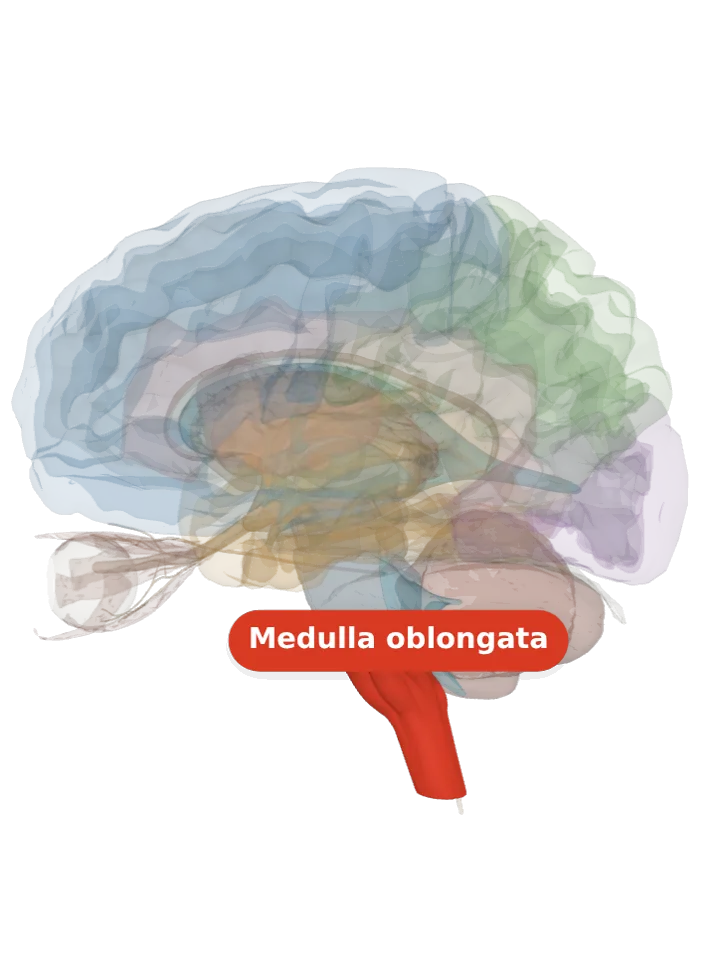
Opens cut by a side (sagittal) slice through the medulla oblongata, which holds the nucleus ambiguus. Drag to turn, pinch or scroll to zoom, tap any part to name it; .
Not a separate shape in this atlas; lit: the part that holds it. Lit: the whole medulla oblongata. The nucleus ambiguus lies deep in the outer (lateral) part of the upper (rostral) medulla oblongata, just behind (dorsal to) the inferior olivary nucleus. It is in the medulla, so the pons is not lit. It has no shape of its own in the BodyParts3D model, so nothing is drawn at a guessed point. [1]
Lit here: the medulla oblongata, the part that holds the nucleus ambiguus — see it on its own page.
Its motor fibres leave in the vagus nerve for the muscles of the larynx, the pharynx and the uvula, and in the glossopharyngeal nerve for one throat muscle, the stylopharyngeus. [1][3][4]
It works the muscles of the soft palate, pharynx, larynx and upper oesophagus on its own side, the muscles used for speech and swallowing. [1]
Its outer part, the external formation, holds parasympathetic cells whose fibres slow the heart; with the dorsal vagal nucleus, this outflow lowers the heart’s activity when blood pressure rises quickly. [1]
The external formation also sends fibres that narrow the airways of the lungs (bronchoconstriction). [1]
Connections
It gives fibres to the cranial part of the accessory nerve as well as to the vagus and glossopharyngeal nerves. [1][5]
The solitary nucleus feeds it: in the gag reflex, the signal from the throat reaches the solitary nucleus, which passes it to the nucleus ambiguus, and the answer goes out to the throat muscles. [6]
Other names
“Nucleus ambiguus” is Latin for “ambiguous nucleus”; it was named by Jacob Clarke. [1]
Size
The model has no shape for the nucleus ambiguus itself, so it is not measured here. The medulla oblongata that holds it measures about 33 mm front to back, 41 mm top to bottom and 27 mm side to side on this model (the box it fits in, not its volume). [7]
Facts describe anatomy and normal function only. The 3D model is the adult male BodyParts3D brain (credits and licence); real brains vary in size and shape, so its measurements describe one model, not anyone’s brain.