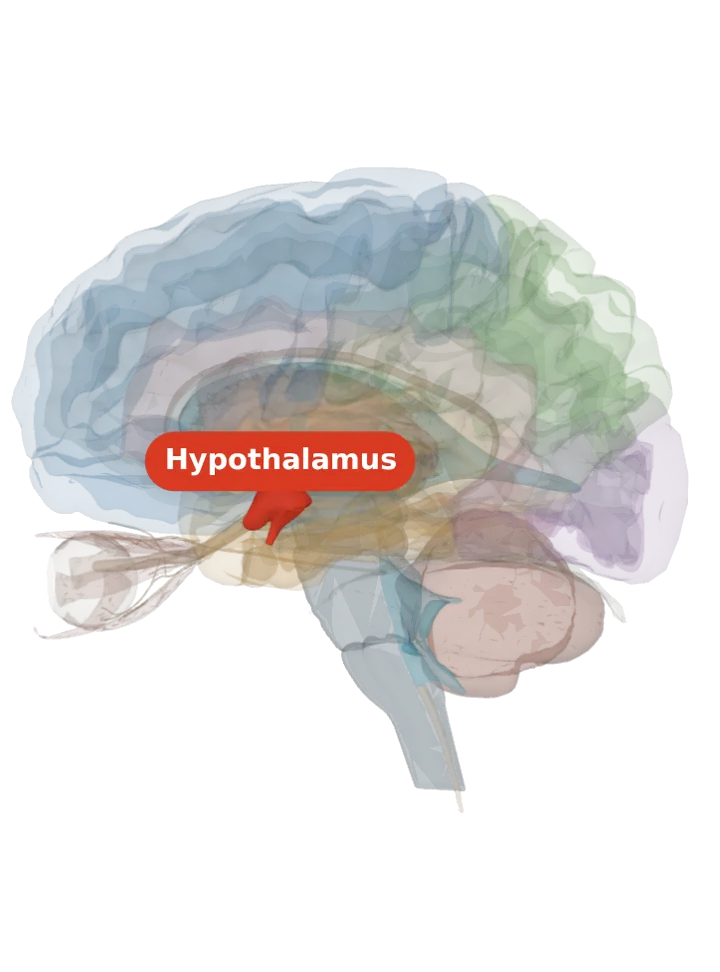
Where it is
- It is the front-most region of the hypothalamus and is classed as part of the anterior hypothalamus; Terminologia Anatomica lists four nuclei in it: medial, median, lateral and periventricular. [2]
- Its medial part, the medial preoptic area (MPOA), lies between the anterior commissure and the optic chiasm, close to the front of the third ventricle; the median preoptic nucleus (MnPO) is a dense cluster of small cells on the midline at the top of that part of the ventricle. [1]
- The ventrolateral preoptic nucleus (VLPO), also called its intermediate nucleus, sits just above and to the side of the optic chiasm. [3]
- The suprachiasmatic nucleus, the body clock, is in the same front part of the hypothalamus, directly above the optic chiasm. [4]
What it does
- It is responsible for thermoregulation: it takes in temperature readings from the skin, the mucous membranes and the hypothalamus itself, and its thermosensitive neurons drive heat loss or heat gain. [2][5][6]
- Its ventrolateral nucleus is most active in non-REM sleep, when it releases the inhibitory transmitters GABA and galanin onto the arousal system that keeps the brain awake; GABA neurons of the median preoptic nucleus help sleep begin. [3][7]
- Sleep and temperature are linked here: in rats and mice the brain and body cool as sleep begins, in people core temperature starts to fall a few hours before sleep onset, and some preoptic neurons that respond to local warming fire faster during non-REM sleep. [8]
- Rats whose preoptic area has been lesioned or silenced can no longer hold their core temperature steady when the room is made hot (35–43 °C) or cold (−5 to 6 °C). [8]
- Its median preoptic nucleus generates thirst and helps keep the body’s water and salt balance. [2][7]
- The medial preoptic area takes part in parental care in both males and females; its medial nucleus is larger in males than in females, and the hypothalamus’s best-known sexually dimorphic nucleus lies in this area. [2][5]
- Honest limit: most of the cell-by-cell mapping comes from mice and rats, and how far the warm-sensitive neurons and the sleep-promoting neurons are the same cells is still largely unknown. [8]
Connections
- Preoptic neurons that reach the wake-promoting histamine neurons of the tuberomammillary nucleus are largely GABAergic, that is, inhibitory. [8]
- It receives the body clock’s timing indirectly, from the suprachiasmatic nucleus by way of the subparaventricular zone and the dorsomedial hypothalamus. [8]
- Neurons of the lateral parabrachial nucleus in the pons relay cold signals from the skin up to it. [9][10]
Other names
Size
- The model has no shape for the preoptic area itself, so it is not measured here. The hypothalamus that holds it measures about 18 mm front to back, 20 mm top to bottom and 17 mm side to side on this model (the box it fits in, not its volume). [11]