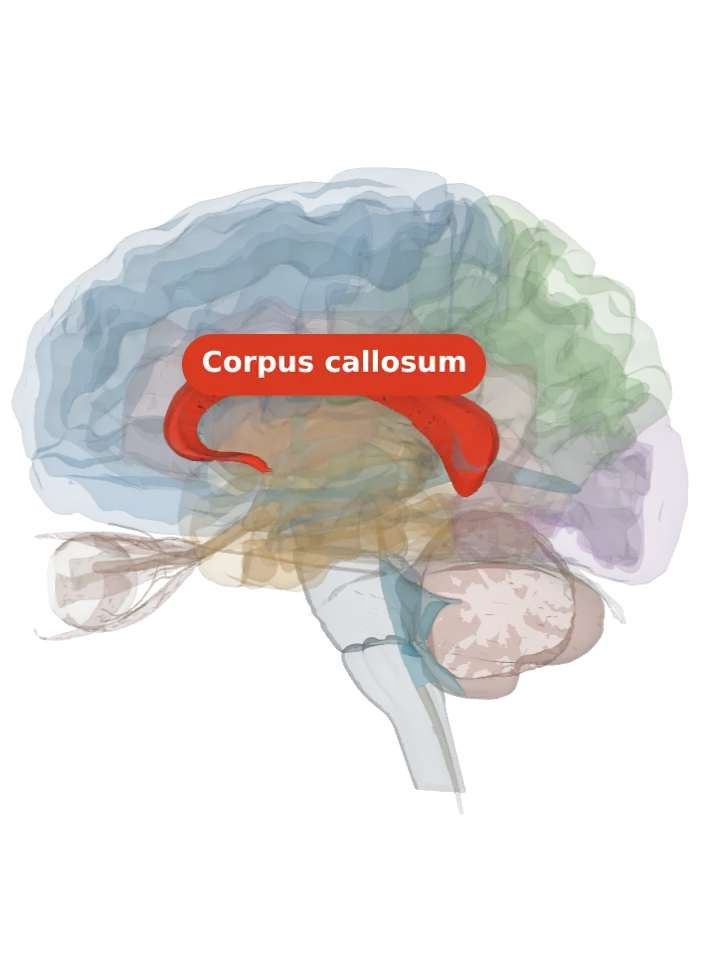
Where are the rostrum, genu, body and splenium of the corpus callosum?
Seen in a midline cut, the corpus callosum is a C-shaped arch with four named parts. From front to back: the rostrum, a thin beak curving down and back underneath; the genu (“knee”), the bend at the front; the body or trunk, the long flat middle; and the splenium, the thickest part, at the back end. [1]
Opens cut down the midline and seen from the side, so the whole corpus callosum shows as one lit arch. Follow it from the front: the thin rostrum tucked underneath, the genu where it bends at the front, the long flat body along the top, and the thick, rounded splenium at the back end, above the midbrain. Drag to turn, pinch or scroll to zoom, tap any part to name it; .
Lit: the whole corpus callosum. This atlas draws the part it lies in as one shape, so it cannot be lit apart; lit: that whole part. The rostrum, genu, body and splenium are named stretches of one continuous band of fibres, with no groove between them. BodyParts3D draws the corpus callosum as a single shape, so the whole arch is lit and no line is drawn between its parts. [1][2]
Held by the corpus callosum — see the whole callosum on its own page.
Where it is
The rostrum is the front-most part on the underside: below the genu it curves down and back, thinning greatly, and below it joins the lamina terminalis. The name means “beak”. [1]
The genu (“knee”) is the front end, facing the frontal lobes: there the band bends downward and backward in front of the septum pellucidum. [1]
The body, or trunk, is the long middle stretch between the genu and the splenium; it forms the floor of the longitudinal fissure, and the cingulate gyrus lies right above it across the callosal sulcus. [1][3]
The splenium is the back end, towards the cerebellum, and the thickest part. It lies over the tela choroidea of the third ventricle and the midbrain and ends in a thick, rounded free border. The name comes from the Greek for “bandage”. [1]
Out to the sides, off the midline: fibres curving forward from the genu into the frontal lobes form the forceps minor (forceps anterior); fibres curving backward from the splenium into the occipital lobes form the forceps major (forceps posterior). [1]
Fibres of the body and splenium, together called the tapetum (“carpet”), form the roof of each lateral ventricle and reach out into the temporal lobes. [1]
What it does
Genu: its thinner fibres join the prefrontal cortex of the left and right hemispheres; they fan out as the forceps minor. [1]
Body: its thicker fibres join the motor areas of the two hemispheres, with a larger share given to the supplementary motor regions. [1]
Splenium: it carries touch and body-position (somatosensory) information between the two parietal lobes and visual information between the two occipital lobes; these are the fibres of the forceps major. [1]
How large, how myelinated and how densely packed the fibres are differs from part to part, matching the regions each part connects. [1]
Connections
The anterior cerebral arteries touch the underside of the rostrum, arch over the front of the genu and run back along the body, supplying the front four-fifths of the corpus callosum. [1][4]
The tapetum and the anterior commissure share the work of connecting the left and right temporal lobes. [1]
Other names
Rostrum is Latin for “beak”, genu for “knee” and splenium comes from the Greek for “bandage”. The body is also called the trunk; the forceps minor and major are also called the forceps anterior and posterior. [1]
Size
This model draws the rostrum, genu, body and splenium only as the one shape of the whole corpus callosum, so no part is measured on its own. Measured from the model instead: the whole corpus callosum measures about 92 mm front to back, 39 mm top to bottom and 51 mm side to side (the box it fits in, not its volume or its length along its curve). [2]
Facts describe anatomy and normal function only. The 3D model is the adult male BodyParts3D brain (credits and licence); real brains vary in size and shape, so its measurements describe one model, not anyone’s brain.